Import
Local video file, audio file (MP3, WAV…) or YouTube link with a resolution picker (up to 4K).
1-click video translation and dubbing, in your own voice. 100% local, no API keys, no subscription.
ZastTranslate is an open-source app for Pinokio. It transcribes a video with WhisperX, separates voice from music with Demucs, translates with a local language model (Qwen, EuroLLM), then re-synthesizes the speaker's voice in 33 languages with VoxCPM 2. Everything runs on your PC: your videos never leave your machine.
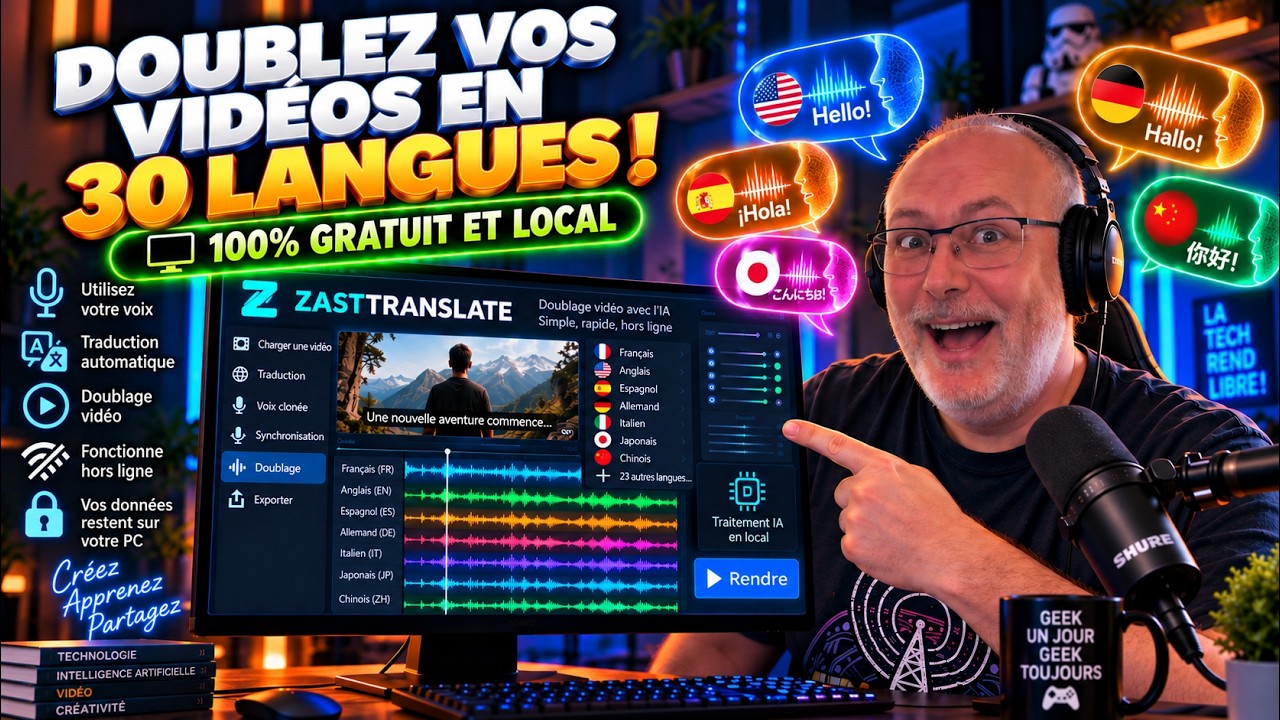 How to dub any video with your own voice, for free, with local AIThe complete step-by-step walkthrough, from installation to multi-language dubbing with voice cloning and subtitle stabilization. The video is in French.Watch on YouTube →
Local video file, audio file (MP3, WAV…) or YouTube link with a resolution picker (up to 4K).
WhisperX with word-level timestamps and an 8-step subtitle stabilization (no one-word cues, no overlapping timecodes).
Demucs isolates the voice from music and effects, then remixes them with the dubbed voice.
Qwen2.5, Qwen3.5 or EuroLLM. Two versions: a faithful translation and a shortened "Fitted" version that fits each segment's duration.
VoxCPM 2 clones the speaker's voice (or a 10 to 30 s sample) in 30 languages, with no API key.
Interactive timeline: click to seek, adjust start and end, fix the text, re-synthesize a single line.
Several languages at once: dubbed videos, audio tracks, subtitles and localized titles/descriptions. The "subtitles and metadata only" mode takes under 15 seconds.
Titles, 200 to 300 word descriptions, full-length chapters and 4 hashtag packs.
Turns a video into an article (meta description, slug, 1080p/2K frames pulled from the video) with copy-ready Gutenberg HTML.
Detects 1 to 5 viral moments, reframes them vertically, adds word-by-word karaoke subtitles.
Qwen-Image-2.1: YouTube thumbnails, RGBA transparency and 3-variant A/B packs. Downloaded only on request (~33 GB).
Every tab has a collapsible guide: goal, options explained and click order.
Drop a video or audio file, or paste a YouTube link.
Pick the source language and Whisper model, review the text, then click "Validate Transcription".
Pick the target language. Edit the translation and the Fitted version, then validate.
Choose a voice mode (default voice, clone from the original, clone from a file) and generate the dubbed MP4.
Bulk mode repeats the process for every language you pick, with SRT, VTT, SBV subtitles and a ZIP archive.
| GPU | NVIDIA with 6 GB VRAM or more (CUDA). RTX 50-series supported. |
|---|---|
| Memory | 16 GB RAM recommended |
| Disk | about 8 GB for models (downloaded on first use) |
| OS | Tested on Windows only (with Pinokio) |
| GPU | NVIDIA with 8 to 12+ GB VRAM (with CPU offload), or 24 GB for native BF16 |
|---|---|
| Memory | 32 GB RAM recommended |
| Disk | about 33 GB for model weights |
The thumbnail studio is optional: the app works fully without downloading it.
Yes. It is open source under the MIT license and runs locally: no API key, no subscription, and your videos are never sent to an online service.
An NVIDIA GPU with 6 GB of VRAM or more, 16 GB of RAM and about 8 GB of disk space for the models. It is tested on Windows with Pinokio.
The VoxCPM 2 voice engine supports 30 languages. The list you see depends on both the voice engine and the translation model: EuroLLM, for example, only covers European languages, while Qwen covers them all.
Yes. The "Clone from original" mode reproduces the speaker's voice from the extracted vocal track. You can also provide a clean 10 to 30 second sample.
No. Transcription, translation and voice are all computed on your machine. The internet is only used to download models and, if you ask for it, a YouTube video.
No. Everything relies on open models: WhisperX, Demucs, Qwen, EuroLLM and VoxCPM 2.
Use the project update in Pinokio. The version list below summarizes the changes; the full detail is in the GitHub repository.
Qwen-Image-2.1 thumbnail studio (optional): RGBA transparency, 12 styles, 3-variant A/B packs, AI metadata stripped on export. Cleanup scripts and buttons to free VRAM and disk.
Quadruple acceleration with zero quality loss (voice caching, NVENC encoding, C++ GGUF engine, KV cache). No more dangling sentence fragments in subtitles. Complete SEO titles.
Much faster translation and Fitted pipeline, VRAM protection on 8 GB cards.
Subtitle pipeline overhaul (4 critical bugs), 222-rule correction dictionary, Blog Studio, viral Shorts, YouTube SEO kit.
YouTube SEO Studio, full-timeline chapters, landmark detection, 4 hashtag packs, subtitles & metadata only mode.
NVIDIA RTX 50-series (Blackwell, CUDA 12.8), WhisperX priming with tech vocabulary, brand name normalizer.
Filler word cleanup, SRT, VTT and SBV export, YouTube title and description localization.
Interactive segment editor with timeline, click to seek, single-line re-synthesis.
ZastTranslate builds on excellent open projects:

I am Zast, a French web creator since 1996: CineAlliance (1998), ParadoxeTemporel (2011), MusiqueAlliance (2014), VisiteEnFamille (2016). I built ZastTranslate to translate my own YouTube videos without relying on a paid service, then opened it to everyone.